Courts That Review Cases Appealed From the District Courts Are Called
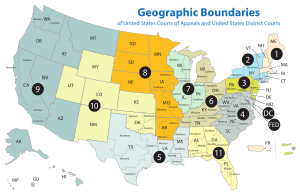
Map of the geographic boundaries of the various The states courts of appeals and Usa district courts
The U.s.a. courts of appeals or circuit courts are the intermediate appellate courts of the United States federal judiciary.[1] The courts are divided into 13 circuits that each hear appeals from the district courts within their borders, or in some instances from other designated federal courts and administrative agencies. Appeals from the circuit courts are taken to the Supreme Court of the United States. The district and appellate courts and the Supreme Courts are all authorized under Article 3 of the United States Constitution.
The The states courts of appeals are considered the most powerful and influential courts in the Usa after the Supreme Court. Considering of their ability to set legal precedent in regions that cover millions of Americans, the United states courts of appeals take strong policy influence on U.Southward. law. Moreover, because the Supreme Court chooses to review fewer than three% of the 7,000 to 8,000 cases filed with information technology annually,[2] the U.S. courts of appeals serve as the final arbiter on almost federal cases.
At that place are currently 179 judgeships on the U.South. courts of appeals authorized by Congress in 28 UsaC. § 43 pursuant to Commodity Three of the U.S. Constitution. Like other federal judges, they are nominated by the President of the United States and confirmed past the The states Senate. They have lifetime tenure, earning (every bit of 2019) an almanac salary of $223,700.[3] The bodily number of judges in service varies, both considering of vacancies and because senior judges who continue to hear cases are not counted against the number of authorized judgeships.
The eleven numbered circuits and the D.C. Circuit are geographically divers past the boundaries of their assigned U.S. district courts. The 10th Circuit is unique in that information technology contains a pocket-sized portion of Idaho and Montana, both in the Ninth Circuit, due to the U.South. District Court for the District of Wyoming extending out of state to cover all of Yellowstone National Park. The 13th courtroom of appeals is the Federal Circuit, which has nationwide jurisdiction over certain appeals based on specialized field of study matter. All of the courts of appeals also hear appeals from some administrative agency decisions and rulemaking, with by far the largest share of these cases heard past the D.C. Circuit. The Federal Excursion hears appeals from specialized trial courts, primarily the The states Court of International Merchandise and the United States Court of Federal Claims, every bit well every bit appeals from the district courts in patent cases and sure other specialized matters.
Decisions of the U.S. courts of appeals accept been published by the individual company West Publishing in the Federal Reporter series since the courts were established. Only decisions that the courts designate for publication are included. The "unpublished" opinions (of all but the Fifth and Eleventh Circuits) are published separately in West'southward Federal Appendix, and they are also available in on-line databases like LexisNexis or Westlaw. More recently, court decisions have as well been made available electronically on official court websites. However, in that location are also a few federal court decisions that are classified for national security reasons.
The circuit with the smallest number of appellate judges is the Kickoff Circuit, and the 1 with the largest number of appellate judges is the geographically large and populous Ninth Circuit in the Far Westward. The number of judges that the U.Due south. Congress has authorized for each circuit is ready forth by police in 28 U.S.C. § 44, while the places where those judges must regularly sit to hear appeals are prescribed in 28 U.Due south.C. § 48.
Although the courts of appeals are frequently called "circuit courts", they should not be confused with the erstwhile United States circuit courts, which were active from 1789 to 1911, during the time when long-altitude transportation was much less available, and which were primarily first-level federal trial courts that moved periodically from place to place in "circuits" in club to serve the dispersed population in towns and the smaller cities that existed then. The current "courts of appeals" arrangement was established in the Judiciary Act of 1891, besides known as the Evarts Human activity.[four]
Procedure [edit]
Because the courts of appeals possess only appellate jurisdiction, they do not concur trials. Only courts with original jurisdiction hold trials and thus determine punishments (in criminal cases) and remedies (in civil cases). Instead, appeals courts review decisions of trial courts for errors of police. Accordingly, an appeals court considers only the record (that is, the papers the parties filed and the transcripts and any exhibits from any trial) from the trial court, and the legal arguments of the parties. These arguments, which are presented in written form and can range in length from dozens to hundreds of pages, are known as briefs. Sometimes lawyers are permitted to add to their written briefs with oral arguments earlier the appeals judges. At such hearings, only the parties' lawyers speak to the courtroom.
The rules that govern the process in the courts of appeals are the Federal Rules of Appellate Procedure. In a courtroom of appeals, an appeal is almost ever heard by a "panel" of three judges who are randomly selected from the available judges (including senior judges and judges temporarily assigned to the circuit). Some cases, all the same, receive an en banc hearing. Except in the Ninth Circuit Court, the en banc court consists of all of the circuit judges who are on active status, only it does not include the senior or assigned judges (except that under some circumstances, a senior judge may participate in an en banc hearing when he or she participated at an earlier stage of the same instance).[five] Because of the large number of Appellate Judges in the Ninth Circuit Court of Appeals (29), simply ten judges, chosen at random, and the Chief Judge hear en banc cases.[6]
Many decades ago, sure classes of federal court cases held the correct of an automated appeal to the Supreme Court of the Us. That is, one of the parties in the example could appeal a decision of a court of appeals to the Supreme Court, and it had to have the instance. The right of automatic appeal for near types of decisions of a courtroom of appeals was ended past an Act of Congress, the Judiciary Act of 1925, which as well reorganized many other things in the federal court system. Passage of this law was urged by Main Justice William Howard Taft.
The current procedure is that a party in a case may apply to the Supreme Court to review a ruling of the circuit court. This is called petitioning for a writ of certiorari, and the Supreme Courtroom may choose, in its sole discretion, to review any lower courtroom ruling. In extremely rare cases, the Supreme Court may grant the writ of certiorari before the judgment is rendered by the court of appeals, thereby reviewing the lower courtroom's ruling directly. Certiorari before judgment was granted in the Watergate scandal-related case, Us v. Nixon,[7] and in the 2005 determination involving the Federal Sentencing Guidelines, U.s.a. v. Booker.[8]
A court of appeals may besides pose questions to the Supreme Courtroom for a ruling in the midst of reviewing a instance. This procedure was formerly used somewhat commonly, merely now information technology is quite rare. For instance, while betwixt 1937 and 1946 xx 'certificate' cases were accepted, since 1947 the Supreme Courtroom has accepted only 4.[9] The Second Circuit, sitting en banc, attempted to employ this procedure in the case United States v. Penaranda, 375 F.3d 238 (2d Cir. 2004),[10] as a outcome of the Supreme Courtroom'south decision in Blakely v. Washington,[xi] but the Supreme Courtroom dismissed the question. See United States v. Penaranda, 543 U.South. 1117 (2005).[12] The last instance of the Supreme Courtroom accepting a set of questions and answering them was in 1982's City of Mesquite v. Aladdin'southward Castle, Inc, 455 US 283 (1982).[thirteen]
A court of appeals may convene a Bankruptcy Appellate Panel to hear appeals in bankruptcy cases directly from the bankruptcy court of its excursion. As of 2008[update], only the Beginning, Sixth, Eighth, Ninth, and Tenth Circuits have established a Bankruptcy Appellate Panel. Those circuits that do non have a Bankruptcy Appellate Panel have their bankruptcy appeals heard by the district court.[14]
Courts of appeals decisions, different those of the lower federal courts, found bounden precedents. Other federal courts in that excursion must, from that signal forward, follow the appeals court'southward guidance in similar cases, regardless of whether the trial judge thinks that the instance should be decided differently.
Federal and country laws tin and do alter from fourth dimension to time, depending on the deportment of Congress and the land legislatures. Therefore, the constabulary that exists at the time of the appeal might be different from the law that existed at the time of the events that are in controversy under civil or criminal police force in the case at hand. A court of appeals applies the law every bit information technology exists at the time of the appeal; otherwise, it would be handing downwards decisions that would be instantly obsolete, and this would be a waste of time and resource, since such decisions could not exist cited equally precedent. "[A] court is to apply the law in effect at the time it renders its decision, unless doing and then would consequence in manifest injustice, or there is statutory direction or some legislative history to the contrary."[15]
Yet, the above dominion cannot apply in criminal cases if the effect of applying the newer law would be to create an ex post facto law to the detriment of the defendant.
Decisions fabricated by the circuit courts merely apply to united states of america within the court's oversight, though other courts may use the guidance issued by the circuit courtroom in their own judgments. While a single example tin can only exist heard by one excursion court, a core legal principle may be tried through multiple cases in separate circuit courts, creating an inconsistency between different parts of the United states. This creates a dissever conclusion among the excursion courts. Often, if there is a split up conclusion betwixt ii or more circuits, and a related case is petitioned to the Supreme Court, the Supreme Court will take that example every bit to resolve the split.
Attorneys [edit]
In order to serve as counsel in a case appealed to a excursion court, the attorney must beginning be admitted to the bar of that circuit. Admission to the bar of a circuit court is granted every bit a matter of course to any attorney who is admitted to exercise law in any state of the United States. The attorney submits an awarding, pays a fee, and takes the oath of admission. Local do varies equally to whether the oath is given in writing or in open court earlier a guess of the circuit, and most courts of appeals permit the bidder attorney to choose which method he or she prefers.
Nomenclature [edit]
When the courts of appeals were created in 1891, one was created for each of the nine circuits then existing, and each court was named the "United States Circuit Courtroom of Appeals for the _____ Circuit". When a court of appeals was created for the District of Columbia in 1893, information technology was named the "Court of Appeals for the District of Columbia", and it was renamed to the "United States Court of Appeals for the District of Columbia" in 1934. In 1948, Congress renamed all of the courts of appeals then existing to their current formal names: the court of appeals for each numbered excursion was named the "Us Courtroom of Appeals for the _____ Circuit", and the "U.s.a. Courtroom of Appeals for the Commune of Columbia" became the "United States Courtroom of Appeals for the Commune of Columbia Circuit". The Tenth Circuit was created in 1929 by subdividing the existing Eighth Circuit, and the Eleventh Circuit was created in 1981 past subdividing the existing Fifth Circuit. The Federal Circuit was created in 1982 by the merger of the The states Court of Customs and Patent Appeals and the appellate division of the United States Court of Claims.
Judicial councils [edit]
Judicial councils are panels in each circuit that are charged with making "necessary and appropriate orders for the effective and expeditious administration of justice" within their circuits.[sixteen] [17] Amid their responsibilities is judicial discipline, the formulation of circuit policy, the implementation of policy directives received from the Judicial Conference of the Usa, and the annual submission of a written report to the Administrative Office of the United States Courts on the number and nature of orders entered during the year that chronicle to judicial misconduct.[16] [xviii] Judicial councils consist of the chief judge of the circuit and an equal number of circuit judges and district judges of the circuit.[16] [nineteen]
Circuit composition [edit]
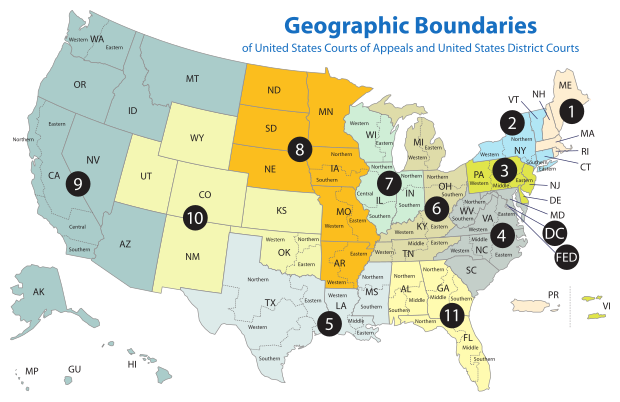
Map of the boundaries of the United states of america courts of appeals and United States commune courts
The courts of appeals, and the lower courts and specific other bodies over which they have appellate jurisdiction, are as follows:
| First Circuit (Boston)
Second Circuit (New York City)
Third Excursion (Philadelphia)
Fourth Circuit (Richmond)
Fifth Circuit (New Orleans)
| Sixth Circuit (Cincinnati)
Seventh Excursion (Chicago)
Eighth Circuit (St. Louis)
Ninth Circuit (San Francisco)
| 10th Circuit (Denver)
Eleventh Circuit (Atlanta)
District of Columbia Circuit (Washington)
Federal Circuit (Washington)
|
- ^ a b c These are article Four territorial courts and are therefore non part of the federal judiciary.
- ^ The Federal Circuit likewise has appellate jurisdiction over certain claims filed in whatever commune court.
- ^ a b These are article I tribunals and are therefore non part of the federal judiciary.
- ^ a b c d eastward f g h These are administrative bodies within the executive co-operative and are therefore not part of the federal judiciary.
- ^ This is an authoritative body within the legislative branch are therefore non function of the federal judiciary.
Circuit population [edit]
Based on 2020 United states of america Demography figures, the population residing in each circuit is as follows.[20] [21]
| Excursion | Authorized judges | Population | Percentage of U.s.a. population | Population per authorized gauge |
|---|---|---|---|---|
| D.C. Excursion | 11 | 689,545 | 0.21% | 62,685 |
| 1st Circuit | 6 | 14,153,058 | 4.23% | 2,358,843 |
| 2nd Circuit | 13 | 24,450,270 | 7.30% | one,880,790 |
| third Circuit | 14 | 23,368,788 | 6.98% | i,669,199 |
| fourth Circuit | 15 | 32,160,146 | 9.61% | two,144,010 |
| fifth Excursion | 17 | 36,764,541 | 10.97% | 2,162,620 |
| 6th Circuit | xvi | 33,293,455 | 9.94% | 2,080,841 |
| 7th Circuit | 11 | 25,491,754 | 7.60% | 2,317,432 |
| 8th Excursion | 11 | 21,690,565 | 6.47% | i,971,870 |
| 9th Excursion | 29 | 67,050,034 | 20.01% | 2,312,070 |
| 10th Circuit | 12 | xviii,636,936 | 5.56% | i,553,078 |
| 11th Excursion | 12 | 37,274,374 | 11.13% | 3,106,198 |
| Federal Excursion[Annotation 1] | 12 | N/A | N/A | N/A |
| Total | 179 | 335,023,466 [Note 2] | 100% | ane,871,639 |
History [edit]
The Judiciary Deed of 1789 established 3 circuits, which were groups of judicial districts in which U.s.a. circuit courts were established.[22] The original three circuits were given distinct names, rather than numbers: the Eastern, the Centre, and the Southern.[22] Each circuit courtroom consisted of two Supreme Courtroom justices and the local district judge; the three circuits existed solely for the purpose of assigning the justices to a group of circuit courts. Some districts (generally the ones well-nigh hard for an itinerant justice to attain) did not have a circuit court; in these districts the district court exercised the original jurisdiction of a excursion court. As new states were admitted to the Union, Congress often did not create circuit courts for them for a number of years.
The number of circuits remained unchanged until the year after Rhode Island ratified the Constitution, when the Midnight Judges Act reorganized the districts into six numbered circuits, and created circuit judgeships and then that Supreme Court justices would no longer take to ride excursion. This Human action, all the same, was repealed in March 1802, and Congress provided that the quondam circuit courts would be revived as of July 1 of that twelvemonth. Only information technology then passed the new Judiciary Act of 1802 in April, and so that the revival of the old courts never took outcome. The 1802 Human action restored circuit riding, just with but one justice to a excursion; information technology therefore created six new circuits, merely with slightly unlike compositions than the 1801 Deed. These six circuits later were augmented by others. Until 1866, each new circuit (except the curt-lived California Circuit) was accompanied past a newly created Supreme Court seat.
| State | Judicial District(s) created | Circuit assignment(due south) |
|---|---|---|
| New Hampshire | 1789 | Eastern, 1789–1801 1st, 1801– |
| Massachusetts | 1789 | Eastern, 1789–1801 1st, 1801– |
| Maine | 1789[Annotation 3] | Eastern, 1789–1801 1st, 1801–1820 1st, 1820– |
| Rhode Isle | 1790 | Eastern, 1790–1801 1st, 1801– |
| Connecticut | 1789 | Eastern, 1789–1801 2d, 1801– |
| New York | 1789 | Eastern, 1789–1801 2nd, 1801– |
| New Bailiwick of jersey | 1789 | Middle, 1789–1801 third, 1801– |
| Pennsylvania | 1789 | Heart, 1789–1801 3rd, 1801– |
| Delaware | 1789 | Middle, 1789–1801 tertiary, 1801–1802 4th, 1802–1866 3rd, 1866– |
| Maryland | 1789 | Heart, 1789–1801 quaternary, 1801– |
| Virginia | 1789 | Middle, 1789–1801 4th, 1801–1802 5th, 1802–1842 4th, 1842– |
| Kentucky | 1789[Annotation 4] | 6th, 1801–1802 seventh, 1807–1837 8th, 1837–1863 sixth, 1863– |
| N Carolina | 1790 | Southern, 1790–1801 5th, 1801–1842 sixth, 1842–1863 4th, 1863– |
| South Carolina | 1789 | Southern, 1789–1801 5th, 1801–1802 6th, 1802–1863 fifth, 1863–1866 quaternary, 1866– |
| Georgia | 1789 | Southern, 1789–1801 5th, 1801–1802 6th, 1802–1863 fifth, 1863–1981 11th, 1981– |
| Vermont | 1791 | Eastern, 1791–1801 2nd, 1801– |
| Tennessee | 1796 | 6th, 1801–1802 7th, 1807–1837 eighth, 1837–1863 6th, 1863– |
| Ohio | 1801 (abolished 1802)[Note 5] | 6th, 1801–1802 |
| Ohio | 1803 | seventh, 1807–1866 6th, 1866– |
| Louisiana | 1812 | 9th, 1837–1842 (Eastern District) 5th, 1842–1863 6th, 1863–1866 fifth, 1866– |
| Indiana | 1816 | 7th, 1837– |
| Mississippi | 1817 | 9th, 1837–1863 fifth, 1863– |
| Illinois | 1818 | 7th, 1837–1863 8th, 1863–1866 seventh, 1866– |
| Alabama | 1819 | 9th, 1837–1842 fifth, 1842–1981 11th, 1981– |
| Missouri | 1821 | 8th, 1837–1863 9th, 1863–1866 eighth, 1866– |
| Arkansas | 1836 | 9th, 1837–1851 9th, 1851–1863 (Eastern District) sixth, 1863–1866 (Eastern District) 8th, 1866– |
| Michigan | 1837 | 7th, 1837–1863 eighth, 1863–1866 6th, 1866– |
| Florida | 1845 | 5th, 1863–1981 11th, 1981– |
| Texas | 1845 | 6th, 1863–1866 5th, 1866– |
| Iowa | 1846 | 9th, 1863–1866 eighth, 1866– |
| Wisconsin | 1848 | 8th, 1863–1866 7th, 1866– |
| California | 1850 | California Circuit, 1855–1863 tenth, 1863–1866 ninth, 1866– |
| Minnesota | 1858 | ninth, 1863–1866 8th, 1866– |
| Oregon | 1859 | tenth, 1863–1866 9th, 1866– |
| Kansas | 1861 | 9th, 1863–1866 8th, 1866–1929 10th, 1929– |
| W Virginia | 1863 | fourth, 1863– |
| Nevada | 1864 | ninth, 1866– |
| Nebraska | 1867 | eighth, 1867– |
| Colorado | 1876 | eighth, 1876–1929 10th, 1929– |
| N Dakota | 1889 | 8th, 1889– |
| South Dakota | 1889 | 8th, 1889– |
| Montana | 1889 | 9th, 1889– |
| Washington | 1889 | 9th, 1889– |
| Idaho | 1890 | ninth, 1890– |
| Wyoming | 1890 | eighth, 1890–1929 10th, 1929– |
| Utah | 1896 | 8th, 1896–1929 10th, 1929– |
| Oklahoma | 1907 | 8th, 1907–1929 tenth, 1929– |
| New United mexican states | 1912 | eighth, 1912–1929 10th, 1929– |
| Arizona | 1912 | 9th, 1912– |
| District of Columbia | 1948[Annotation vi] | District of Columbia Circuit, 1948– |
| Alaska | 1959 | 9th, 1959– |
| Hawaii | 1959 | 9th, 1959– |
| Puerto Rico | 1966[Note 7] | 1st, 1966– |
| Guam | ||
| Virgin Islands | ||
| Philippines | 1898[Annotation 8] | |
| Panama Canal Zone[Note 9] |
See also [edit]
- Commune of Columbia Courtroom of Appeals, a federally established appellate courtroom that is not considered a U.South. court of appeals
- List of electric current U.s. excursion judges
- List of United States courts of appeals cases
- Judicial date history for Usa federal courts
- Us Foreign Intelligence Surveillance Court of Review
- U.s. Court of Appeals for the Armed Forces, an Article I tribunal that hears appeals of court-martial decisions
- United States Courtroom of Appeals for Veterans Claims, an Article I tribunal that reviews decisions of the Board of Veterans' Appeals
- State supreme court
Notes [edit]
- ^ The Federal Circuit'due south jurisdiction is non based on geography; rather, the Federal Excursion has jurisdiction over the entire United States, for certain classes of cases.
- ^ This figure includes the 50 states, D.C., Puerto Rico, Guam, and the Northern Mariana Islands, fifty-fifty though the latter two's commune courts are not federal courts per se as noted above. It excludes American Samoa, as cases from that Us territory'south High Court are appealed straight to the Us Supreme Court.
- ^ The Judiciary Deed of 1789 divided Massachusetts into the Maine District, comprising what is now the State of Maine, and the Massachusetts District, comprising the remainder of the state.
- ^ The Judiciary Human activity of 1789 divided Virginia into the Kentucky Commune, comprising what is now the Commonwealth of Kentucky, and the Virginia District, comprising the remainder of the land.
- ^ The first District of Ohio encompassed the Northwest and Indiana Territories.
- ^ The pre-existing courts of the Commune of Columbia were elevated to United States district court and court of appeals condition in 1948. The courts of the District had been incorporated into the Federal Court Organization by the Judiciary Act of 1925.
- ^ The pre-existing territorial district court of Puerto Rico was elevated to United States district courtroom condition. Appellate jurisdiction from the Puerto Rico courts was assigned to the 1st Circuit in 1915.
- ^ In that location were U.S. Federal Courts in the Philippines following the Spanish–American War of 1898 upwardly through the granting of independence to the Philippines on July 4, 1946—with the exception of the Philippine occupation by the Japanese Army in 1942–45.
- ^ There were formerly U.S. Federal Courts in the Panama Culvert Zone, until that Zone was returned to Panama past treaty on December 31, 1999.
References [edit]
- ^ 28 U.South.C. § 43 provides that "There shall be in each circuit a courtroom of appeals, which shall be a court of record, known as the United states of america Court of Appeals for the excursion".
- ^ "Thee Supreme Court at Work: The Term and Caseload". The states Supreme Court. Retrieved September 12, 2021.
Plenary review, with oral arguments past attorneys, is currently granted in about eighty of those cases each Term, and the Court typically disposes of about 100 or more cases without plenary review.
- ^ Judicial Compensation U.S. Courts. Retrieved five Apr 2020.
- ^ The U.South. Courts of Appeals and the Federal Judiciary, History of the Federal Judiciary, Federal Judicial Centre (final visited March five, 2014).
- ^ See e.g. "IOP 35.1. En Banc Poll and Decision". United States Court of Appeals 2d Circuit . Retrieved September 10, 2020.
- ^ Rule 35-three of the Federal Rules of Appellate Procedure, 9th Circuit Rules. http://cdn.ca9.uscourts.gov/datastore/uploads/rules/frap.pdf
- ^ Usa 5. Nixon, 418 U.S. 683 (1974)
- ^ United States v. Booker, 543 U.S. 220 (2005)
- ^ Aaron Nielson, The Expiry of the Supreme Court'southward Certified Question Jurisdiction, 59 Cath. U. L. Rev. 483 (2010), http://scholarship.law.edu/lawreview/vol59/iss2/5
- ^ "U.s.a. v. Penaranda, 375 F. 3d 238 - Court of Appeals, 2nd Circuit 2004 - Google Scholar".
- ^ Blakely v. Washington, 542 U.Southward. 296 (2004)
- ^ "Usa five. Penaranda, 543 U.S. 1117 | Casetext". casetext.com.
- ^ "Urban center of Mesquite v. Aladdin's Castle, Inc., 455 The states 283 - Supreme Courtroom 1982 - Google Scholar".
- ^ 28 U.S.C § 158 https://www.law.cornell.edu/uscode/text/28/158
- ^ Bradley v. Richmond Sch. Bd., 416 U.Southward. 696, 711-12 (1974)
- ^ a b c Barbour, Emily C. (April seven, 2011), Judicial Subject area Process: An Overview (PDF), Congressional Inquiry Service
- ^ 28 United states of americaC. § 332
- ^ 28 U.S.C. § 332(g)
- ^ 28 U.S.C. § 332(1)(a)
- ^ U.s. Census Bureau. "2020 Population and Housing State Information". Census.gov . Retrieved January 21, 2022.
{{cite web}}: CS1 maint: url-status (link) - ^ U.s.a. Circuit Courts. "Geographic Boundaries of US Courts of Appeals and US District Courts" (PDF).
{{cite web}}: CS1 maint: url-status (link) - ^ a b White, G. Edward (2012). Police force in American History, Volume i: From the Colonial Years Through the Civil War. Oxford and New York: Oxford University Press. p. 197. ISBN9780190634940 . Retrieved January 16, 2022.
External links [edit]
- Info about U.S. courts
- History of the Federal Judiciary (Federal Judicial Center)
- Official site of the U.s. Courts
- The states Appeals Courts @ OpenJurist
- Federal Courtroom Concepts, Georgia Tech
haywoodencted1995.blogspot.com
Source: https://en.wikipedia.org/wiki/United_States_courts_of_appeals
0 Response to "Courts That Review Cases Appealed From the District Courts Are Called"
Post a Comment